
BATTERY BACKUP & BASEMENT FLOOD PREVENTION
Can a Portable Power Station Run a Sump Pump? Startup Power, Runtime, and Automatic Backup
A portable power station can be a useful source of backup electricity for some sump pumps. But matching a pump to a battery requires more than checking the watt-hours on the box. The inverter must start the motor, keep the correct voltage available, and remain ready between pump cycles.
1. Start With the Pump Label and Manual
Record the exact model, voltage, frequency, and electrical ratings. This guide focuses on plug-in household AC sump pumps; it does not cover converting hardwired or 240V equipment.
Horsepower alone is not enough to select a power station. Pumps with the same horsepower can have different electrical demands. Manufacturer specifications and suitable measurements are more useful than a generic horsepower-to-watts chart.
- Voltage and frequency: Match the pump’s supply requirements.
- Running demand: Confirm the inverter can supply the operating load.
- Starting demand: Obtain motor-starting information or qualified testing.
- Supply requirements: Check grounding, protective devices, approved connection methods, and inverter compatibility.
Volts multiplied by amps gives apparent power in volt-amperes. For an AC motor, that is not automatically its real watt consumption, and it does not establish the starting surge.
Related guide: How Many Watts Does a Sump Pump Need?
2. Can the Inverter Start the Motor?
A station with enough continuous output can still trip when the pump starts. Check the inverter’s surge rating and permitted surge duration against the pump’s actual starting requirements.
Illustrative example: If a pump requires 800W while running and 2,200W briefly at startup, a 1,000W inverter is not automatically suitable. It must also support the startup demand for long enough. These figures are hypothetical, not specifications for a particular pump.
Look for a pure sine wave supply and confirm acceptance with the pump and power-station manufacturers. Do not treat a marketed appliance-boost mode as equivalent to full-voltage motor-starting capacity.
See Starting Watts vs. Running Watts .
3. Runtime Depends on How Often the Pump Runs
A sump pump usually cycles as water rises and falls. Battery endurance therefore depends on both electrical demand and the fraction of time the pump runs. Rainfall and groundwater conditions can change that fraction substantially.
Average demand ≈ pump running watts × duty cycle + power-station overhead.
Estimated hours ≈ usable battery energy ÷ average demand.
Use consistent measurements: do not subtract conversion losses again if they are already included in your usable-energy figure.
Duty cycle is the fraction of an observation period spent pumping. Two minutes on during a ten-minute period is a 20% duty cycle.
| Pump duty cycle | Average demand | Calculated runtime |
|---|---|---|
| 10% | 95W | 10.5 hours |
| 25% | 215W | 4.7 hours |
| 50% | 415W | 2.4 hours |
| 100% | 815W | 1.2 hours |
These are simplified calculations with no additional reserve and no separate allowance for repeated starting energy. They are not product test results. Actual endurance varies with battery condition, temperature, inverter efficiency, cutoff settings, pump operation, and changing water inflow.
A quiet-weather test cannot guarantee storm runtime. Plan reserve capacity and a second response if the battery reaches its low-charge threshold.
Use our battery runtime calculator for initial estimates, then verify with your equipment.
4. Running the Pump Is Different From Automatic Backup
A station that powers the pump after you manually move its plug may help during an attended outage. It does not automatically protect the basement when you are away.
If you want continuous inline backup, confirm that both manufacturers permit the arrangement. Check pass-through current limits, transfer behavior, charging requirements, and whether the inverter can handle a pump start after utility power fails.

Check low-load and timeout settings
Between cycles, the pump may draw little or no power. A power-saving timeout could switch the AC output off before the next cycle.
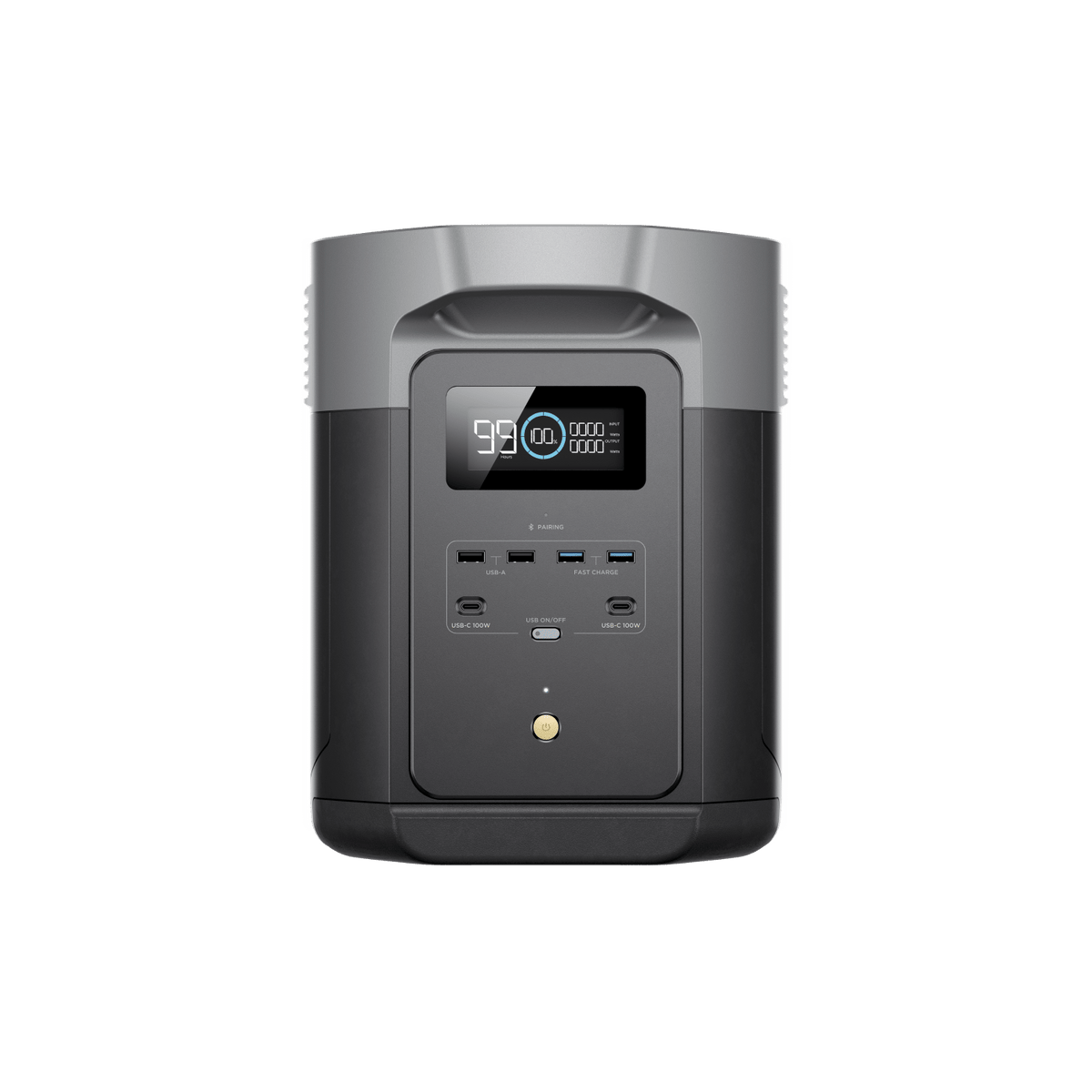
For example, EcoFlow’s DELTA 2 Max app manual describes separate unit and AC timeout controls, with an always-on option. Verify the current settings for your exact device and firmware. A sleeping display is different from an outlet that has turned off.
Also check what happens after a depleted battery recharges or an overload clears. Automatic restart behavior must be verified rather than assumed.
5. Keep the Power Station and Connections Dry
Locate the station on a stable, dry surface above plausible floodwater, within its ventilation and temperature requirements. Keep connections away from the sump opening and potential spray. Do not seal the station in an unventilated box.
Follow the pump’s connection rules. Some pump manuals prohibit extension cords. If the factory cord cannot reach a suitable dry location, have an electrician plan an approved arrangement instead of adding an improvised extension.
Do not backfeed a house receptacle. Supplying permanent wiring requires suitable installed transfer equipment and professional verification.
6. Test Before You Need It
- Confirm compatibility and connection requirements with both manuals.
- Charge the station and verify its output and timeout settings.
- Use the pump manufacturer’s functional-test procedure; do not run the pump dry or reach into an energized sump.
- Observe multiple normal starts and stops.
- Verify battery operation after the approved loss-of-utility test.
- Leave an appropriate idle interval and confirm the next pump cycle starts.
- Record energy used and pumping activity without intentionally running the battery to exhaustion during a flood risk.
Stop for faults, abnormal motor sounds, or hot connections. A successful test demonstrates operation under those conditions, not guaranteed protection against every storm.
7. Power Station or Dedicated Battery Backup Pump?
| Option | What it can address | Important limit |
|---|---|---|
| Power station feeding the primary pump | Loss of utility electricity, if compatible and sufficiently charged. | Still depends on the existing pump, float, and discharge path. |
| Dedicated battery-powered backup pump | Can provide a separate pumping mechanism and control. | Needs proper installation, battery maintenance, and sufficient pumping capacity. |
| Generator backup | May support longer operation with fuel and servicing. | Requires safe outdoor operation and an appropriate connection plan. |
A backup pump still needs a suitable discharge arrangement. Neither option cures a blocked discharge pipe or every mechanical failure. Consider an independent high-water alarm and a response plan if water keeps rising.
Frequently Asked Questions
Will a 1,000Wh power station run a sump pump?
Possibly. Watt-hours describe energy capacity, not starting capability. Check the inverter and pump first, then estimate runtime.
Can I buy by pump horsepower alone?
No. Match the actual model’s electrical and starting requirements.
Can solar panels keep it running indefinitely?
Do not assume so. Solar input changes with weather and daylight, and storms may reduce generation when pumping demand is highest.
Can I leave the pump connected all the time?
Only if the complete inline arrangement is approved and tested. Check pass-through limits, timeout settings, transfer behavior, and restart behavior.
Is a computer UPS a substitute?
Not automatically. A UPS must support the motor’s electrical demands and the intended application. Desktop-computer ratings alone do not establish pump compatibility.
Sources and photo credits
- Jackery: Motor-load and startup-surge compatibility
- EcoFlow DELTA 2 Max: Product information and photos
- EcoFlow: App manual and timeout controls
- Zoeller: Example pump electrical and connection requirements
- Zoeller: Dedicated battery-backup pump systems
Runtime figures are illustrative calculations. Product photos do not establish pump compatibility. Follow both equipment manuals and have a qualified professional verify unfamiliar electrical arrangements.