
What Generator Cord Do I Need? Match Your Generator Outlet to Your Home Inlet
Quick answer: Choose a generator cord that matches both your generator outlet and your home power inlet. Then confirm the cord’s current rating, voltage rating, outdoor suitability, and length. A common 30-amp setup uses an L14-30P to L14-30R cord, but 50-amp setups can use different connector combinations. Do not buy by amperage alone.
A generator cord can look right in a product photo and still be wrong for your home. One end may fit your generator perfectly while the other will not connect to your inlet box.
The easiest way to avoid that mistake is to read the labels on your equipment before shopping. Your generator’s advertised wattage does not identify the connectors you need.
The simple generator-cord selection rule
Match both ends + verify ratings + measure the required distance
Start with the outlet on your generator and the inlet on your home. The cord needs a male plug that matches the generator outlet and a female connector that matches the home inlet.
After confirming those connections, check the complete cord assembly’s current and voltage ratings. Finally, choose enough length to place your generator safely outdoors without stretching the cord.
A generator cord is not a substitute for transfer equipment. Supplying permanent house wiring requires a properly installed transfer switch or an approved, panel-compatible interlock arrangement with a suitable inlet. Never connect a generator to a household wall receptacle or use a male-to-male cord. Have a qualified electrician verify your installation, protection requirements, and neutral/ground arrangement.
Identify your generator outlet
Find the outlet you intend to use. Look for its connector designation, voltage, and breaker rating. Record all three before comparing cords.
Your generator may have several outlets with different capabilities. Two outlets can both be rated for 30 amps while supplying different voltages and using different connectors.
- L14-30R: A locking, four-contact receptacle commonly used for 30-amp, 120/240-volt generator connections.
- 14-50R: A four-contact receptacle commonly found on generators with a 50-amp, 120/240-volt connection.
- TT-30R: A 30-amp, 120-volt RV receptacle. It is not a 120/240-volt source.
- L5-30R: A locking 30-amp, 120-volt receptacle. It is different from an L14-30R.
Check your generator’s manual if a label is unclear. A close-up photograph of the outlet and its markings can help when comparing manufacturer specifications.
Identify your home power inlet
A power inlet receives generator power. It is different from an ordinary household outlet, which supplies power to an appliance.
Check the inlet’s connector designation and rating. If you cannot find that information on the inlet, use its model number to find the manufacturer’s instructions.
Do not assume every 50-amp inlet uses the same connector. A product may specify SS2-50 or a California-style locking connection. Use the manufacturer’s specified mating connector rather than choosing by appearance.
If you are still planning the inlet installation, see our generator inlet box installation guide .
Common generator-cord combinations
In connector designations, P identifies a plug and R identifies a receptacle or female cord connector. Match the complete designation, not just the number.
| Generator outlet | Home inlet | Cord example | What to verify |
|---|---|---|---|
| L14-30R | L14-30P | L14-30P to L14-30R; 30A, 125/250V | Complete assembly rating and required length. |
| 14-50R | Inlet specified to accept an SS2-50R cord connector | 14-50P to SS2-50R; 50A, 125/250V | Exact mating connector specified in the inlet manual. |
| TT-30R or L5-30R | Conventional 120/240V home inlet | No direct equivalent to a standard 120/240V source | These outlets provide 120V. A simple adapter cannot create 240V. |
| Unclear or missing designation | Unclear or missing designation | Identify both before buying | Equipment model numbers and manufacturer documentation. |
These are selection examples, not a universal compatibility chart. Your equipment instructions determine which cord is suitable.
A cord’s connector may be labeled 125/250V even though your generator’s nominal output is described as 120/240V. The connector rating describes its intended voltage class; it does not change the voltage produced by the generator.
For help deciding between system sizes, read 30 Amp vs. 50 Amp Generator Setup: What’s the Difference?
Choose enough length for safe generator placement
Measure the actual route from your inlet to a suitable outdoor generator location. Include bends and the distance needed to route the cord around obstacles.
The U.S. Consumer Product Safety Commission advises operating portable generators outdoors, at least 20 feet from homes and buildings, with exhaust directed away from windows, doors, and vents.
A 25-foot cord may be long enough for one property and too short for another. Do not move the generator closer to a building simply because your cord will not reach.
Longer cords can increase voltage drop, especially under heavy loads. Choose enough length for safe placement, then verify that the cord is suitable for the intended load and distance using the manufacturers’ guidance.
Never operate a portable generator in a home, garage, basement, shed, or other enclosed space. Opening a door or window does not make indoor operation safe. Keep working carbon monoxide alarms in your home and follow the generator’s placement instructions.
Check ratings—not just wire gauge
Wire gauge matters, but it is only one part of choosing a generator cord. The connectors, insulation, conductor material, and assembly construction also affect suitability.
Before ordering, check for:
- Correct current rating: The assembly must be suitable for the intended circuit and its overcurrent protection.
- Correct voltage rating: Confirm suitability for your generator output and intended connection.
- Outdoor suitability: Read the jacket markings and manufacturer’s instructions.
- Recognized listing or certification: Look for a recognized testing laboratory mark appropriate to the complete product.
- Undamaged construction: Avoid loose contacts, cracked insulation, scorching, or damaged connector bodies.
Outdoor-rated does not mean connections can sit in standing water. Keep connections protected as directed by the manufacturer, route the cord away from damage, and follow any instructions about uncoiling it during use.
Also remember that a flexible generator cord is different from the permanent wiring between an inlet and your electrical panel. See our generator inlet wire-size guide for that separate planning question.
Two generator-cord examples
The following examples show how to compare product specifications. They are not hands-on reviews, and neither cord fits every setup.
Champion 100395: a matching 30-amp setup
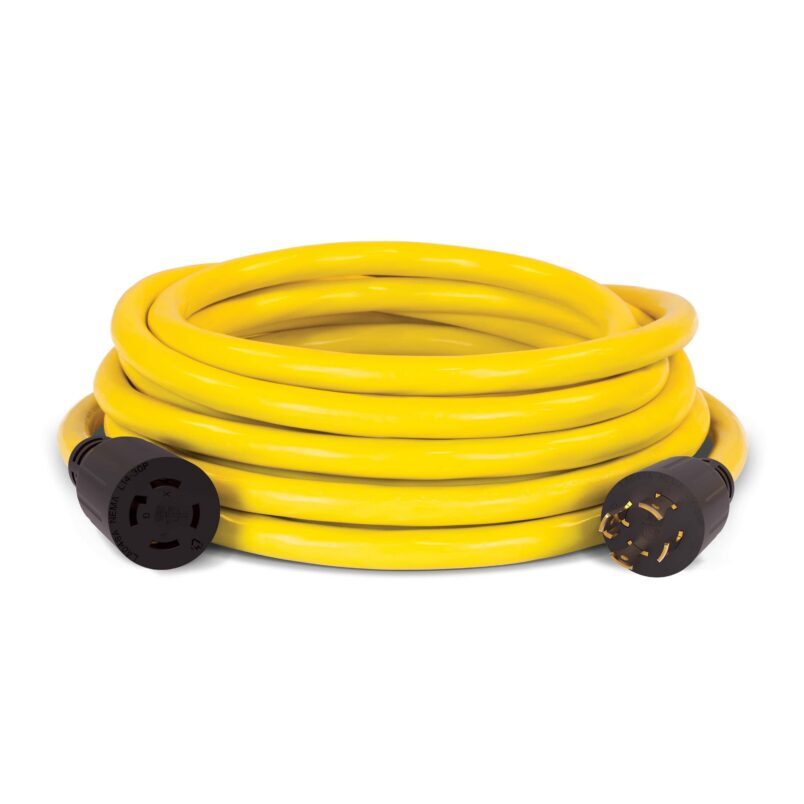
Champion lists the 100395 as a 25-foot, 30A, 125/250V cord with 10 AWG wire and an outdoor-rated SJTW jacket. Its stated application connects an L14-30 generator receptacle to a matching L14-30 transfer-switch connection.
Consider this type of cord when: Your generator outlet, home inlet, and required distance match its specifications. See Champion’s 100395 specifications.
Champion 100828: a matching 50-amp setup
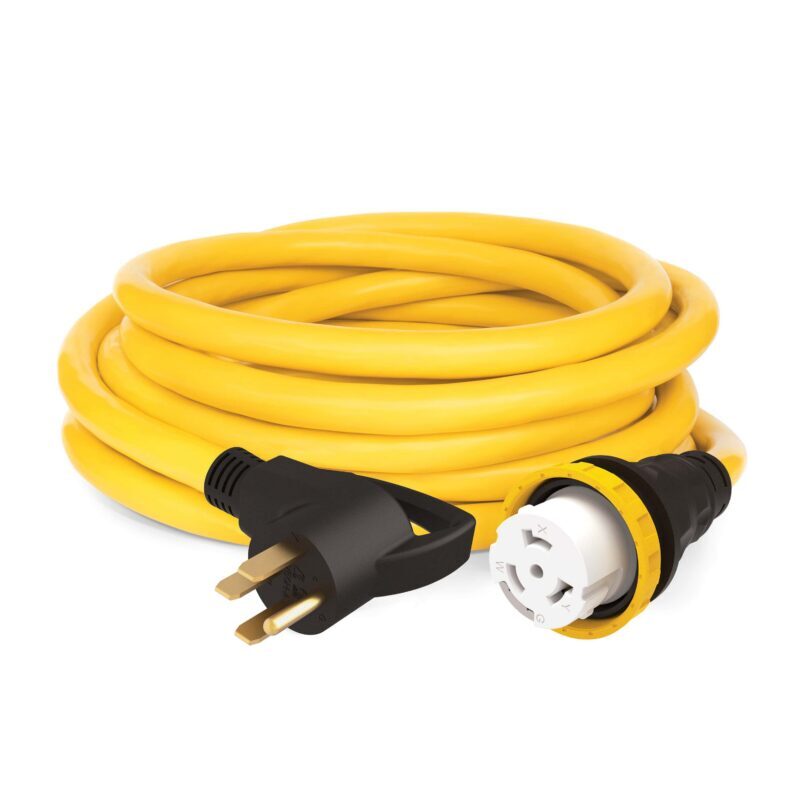
Champion lists the 100828 as a 30-foot, 50A, 125/250V cord with a 14-50P plug and SS2-50R connector. This is an example of why the amperage label alone is not enough.
Consider this type of cord when: Your generator has a matching 14-50R outlet and your inlet manufacturer specifies compatibility with the SS2-50R end. See Champion’s 100828 specifications.
Before buying any model, verify the current product listing, both connector ends, complete assembly rating, length, and return policy. The words “RV cord” or “generator cord” do not establish compatibility by themselves.
Be careful with generator-cord adapters
An adapter changes the physical connection. It does not increase your generator’s output or create a voltage the generator does not supply.
A 120V generator outlet cannot become a true 120/240V source simply by attaching an adapter. Likewise, a larger connector does not give a smaller generator more available power.
Protection matters too. Connecting a lower-rated cord to a higher-rated outlet requires appropriate overcurrent protection. Physical fit alone does not establish that an adapter combination is suitable.
Do not choose an adapter just because both ends fit. Have the equipment manufacturer or a qualified electrician confirm compatibility, voltage, current limits, and protection for the complete arrangement. Never use a male-to-male cord.
Common generator-cord buying mistakes
- Buying by amperage alone: Match the complete connector designation at both ends.
- Confusing 120V with 120/240V: Check the outlet label and generator manual.
- Choosing a cord that is too short: Measure from a safe generator location before ordering.
- Using an ordinary appliance extension cord for a home inlet: These connections serve different purposes.
- Assuming an adapter increases capacity: The generator, circuit protection, and equipment ratings still set the limits.
- Ignoring damaged connectors: Stop using cords with loose contacts, heat damage, or broken insulation.
If a breaker trips, do not bypass it or install a larger breaker just to keep the generator running. Disconnect loads and investigate the cause. Read our generator breaker troubleshooting guide for common possibilities.
Your generator-cord buying checklist
- Record the generator outlet designation, voltage, and breaker rating.
- Record the inlet designation and specified mating connector.
- Confirm that both cord ends match those requirements.
- Verify the complete assembly’s current and voltage ratings.
- Choose a suitable outdoor cord with enough length for safe placement.
- Confirm your transfer equipment and protection arrangements.
- Inspect the cord before use and follow your equipment instructions.
Frequently asked questions
Can I use a 50-amp cord with a 30-amp generator?
Sometimes a properly designed combination is possible, but it depends on the connectors, voltage, protection, and equipment instructions. A higher-rated cord does not increase generator output. Have any adapter arrangement verified before use.
Can I use a 30-amp cord on a 50-amp generator outlet?
Do not assume a plug adapter makes this acceptable. A 30-amp cord requires suitable overcurrent protection. Ask the manufacturer or a qualified electrician to confirm the complete arrangement.
Is a 50-foot cord better than a 25-foot cord?
Only if you need that distance. Choose enough length for safe generator placement and verify suitability for the intended load. Extra length adds weight and can increase voltage drop.
Can a TT-30 outlet run my home’s 240V appliances?
No. TT-30 is a 120V connection. A simple adapter cannot turn it into a true 120/240V source for appliances that require 240V.
Do I still need a transfer switch or interlock?
Yes. Supplying permanent house wiring requires an appropriate installed arrangement that prevents simultaneous connection to generator and utility power. The cord only connects the generator to the inlet.
Choose your cord before the next outage
The right generator cord starts with the labels on your equipment. Match both ends, confirm the ratings, and measure the distance from a safe outdoor generator location. Keep those specifications with your backup-power plan so you can replace the cord without guessing.
Continue planning with our generator-to-transfer-switch guide and generator interlock overview .
Sources: Champion 100395 specifications ; Champion 100828 specifications ; CPSC generator safety guidance . Follow your equipment instructions and applicable local requirements.