
How Many Circuits Can a Generator Transfer Switch Power?
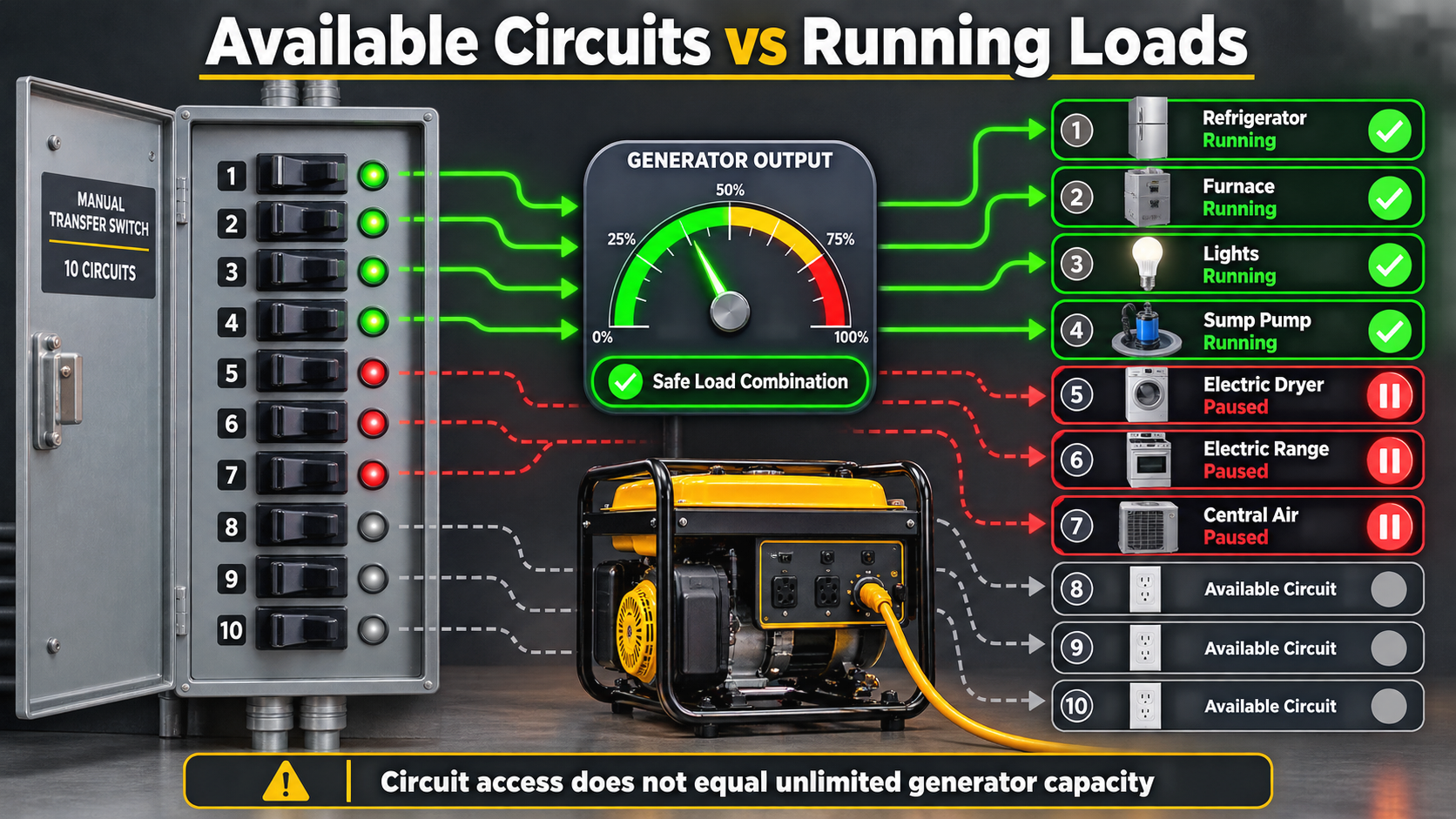
A generator transfer switch can power as few as 4–6 selected circuits, 10 or 16 essential circuits, or an entire electrical panel, depending on the type of switch. But the number of circuits connected to the switch is not necessarily the number you can run simultaneously.
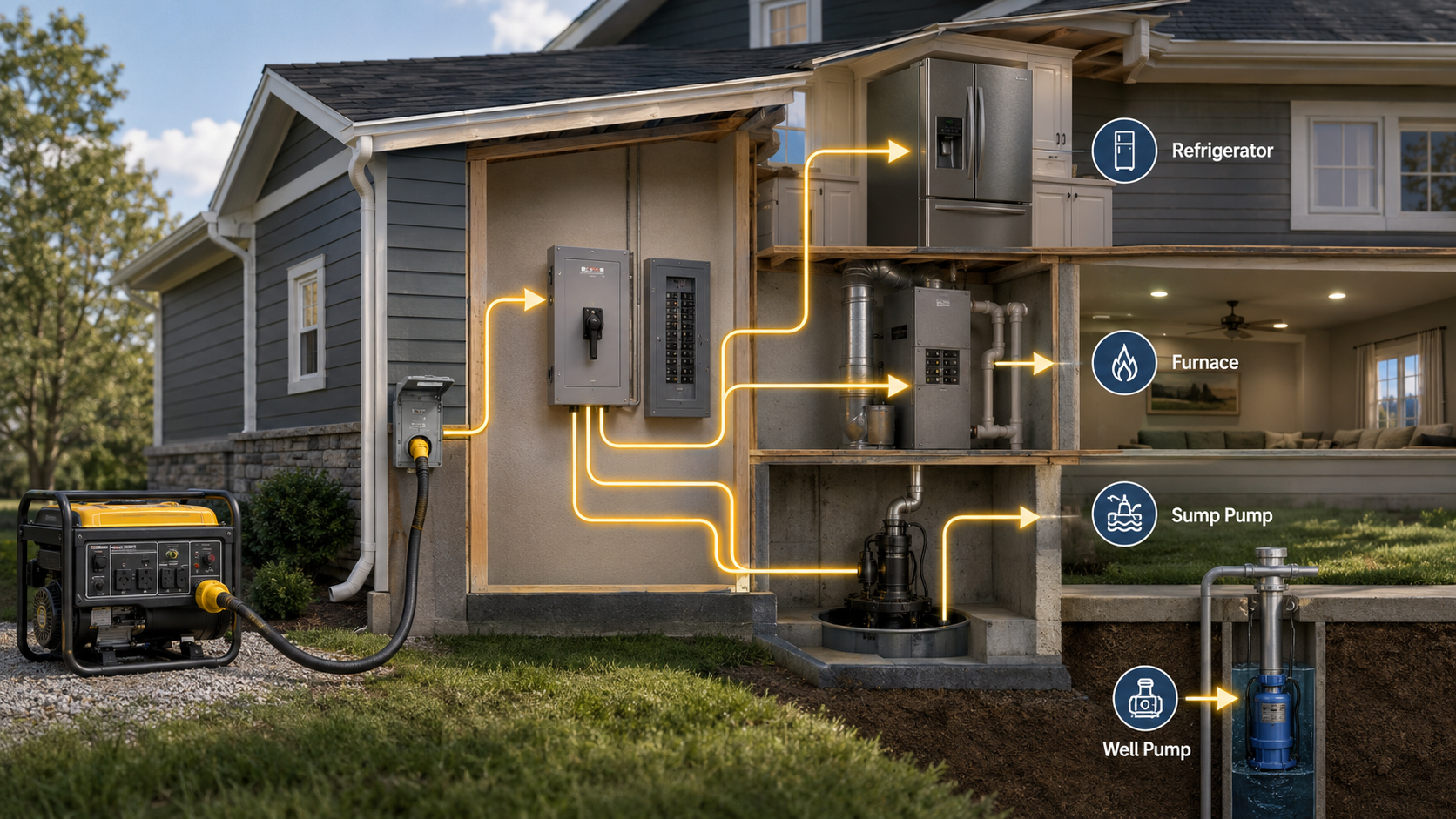
For example, a 7,500-running-watt generator might keep a refrigerator, gas furnace, sump pump, lights, internet equipment and several receptacles operating. It probably cannot run all of those loads while also starting a central air conditioner, electric water heater and electric range.
Circuit Capacity by Transfer-Switch Type
There are two broad residential configurations: a transfer switch that feeds only selected circuits and a switch that transfers power to the main load center.
| Transfer-switch configuration | Typical circuit access | What actually limits operation |
|---|---|---|
| Small prewired manual switch | Commonly 6 circuits | Switch positions, generator output and individual breaker ratings |
| Larger prewired manual switch | Commonly 8–10 or 10–16 circuits | Available positions and generator output |
| Essential-circuit automatic switch | Often 8–16 selected circuits | Integrated load center, generator size and load-management controls |
| Whole-house or service-rated switch | Potential access to the full panel | Generator output; large loads must be managed or turned off |
These are common arrangements, not universal rules. For example, Reliance Controls sells both 6- and 10-circuit portable-generator transfer switches. Generac offers prewired HomeLink models expandable from 8 to 10 or 10 to 16 circuits, as well as whole-house switches that feed a load center while the homeowner limits loads to the generator’s capacity.
A 240-volt load usually occupies two circuit positions
A 240-volt appliance uses a two-pole breaker. In a small prewired transfer switch, that normally consumes two adjacent switch positions. Therefore, a “6-circuit” switch configured for one well pump may provide control for that 240-volt load plus only four separate 120-volt circuits.
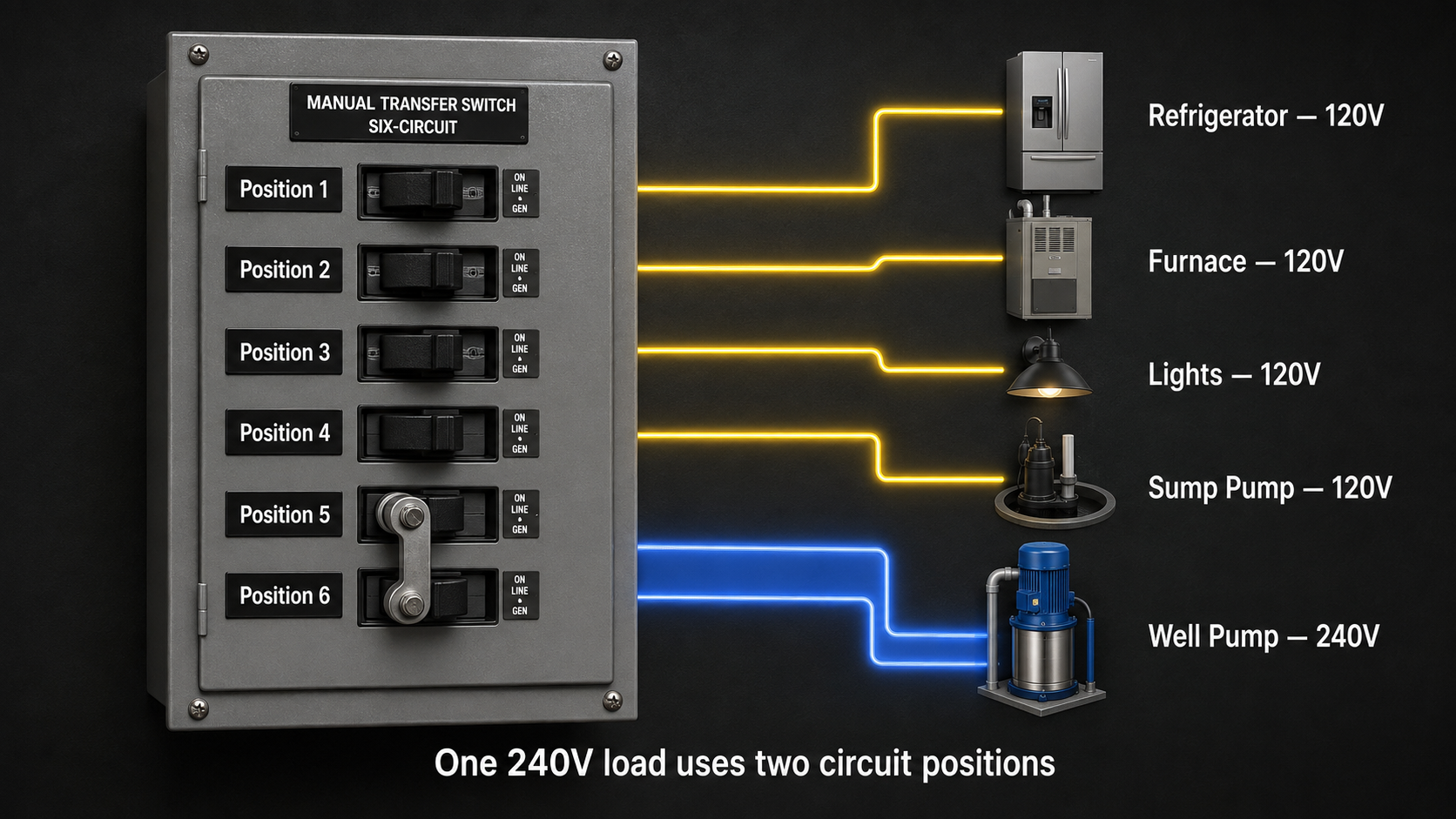
This is one reason to plan by loads and breaker positions, not merely by counting appliances.
The Three Limits That Determine How Many Circuits You Can Power
1. The number of positions in the transfer switch
A selected-circuit transfer switch cannot feed more branch circuits than it is designed to accommodate. If it has six positions, you cannot simply add a seventh circuit unless the manufacturer specifically designed the equipment for expansion.
2. The generator’s usable running output
The running-watt rating—not the larger starting or surge number—is the foundation for planning continuous loads. A generator advertised as “9,500 starting watts / 7,500 running watts” should be treated as a 7,500-watt source for normal load calculations.
The inlet and transfer equipment can impose an additional ceiling:
| Connection | Theoretical maximum at 120/240V | Important qualification |
|---|---|---|
| 30 amp | 7,200 watts | Actual capacity is lower if the generator’s running rating is below 7,200 watts |
| 50 amp | 12,000 watts | A 50A inlet does not turn a smaller generator into a 12,000-watt generator |
The figures above come from volts × amps: 240V × 30A = 7,200W and 240V × 50A = 12,000W. They describe the connection’s upper limit—not a recommendation to operate continuously at its maximum rating.
3. The starting surge and timing of the loads
Motors and compressors can draw considerably more power for a short time while starting. Refrigerators, freezers, well pumps, sump pumps, furnaces and air conditioners are common examples. Two loads that run comfortably together may still overload the generator if both motors start at once.
That is why circuit count alone is a poor measure. Six lightly loaded lighting and receptacle circuits may use less electricity than one large central-air-conditioning circuit.
How to Calculate How Many Circuits Your Generator Can Run
Use this five-step process:
- Write down the generator’s running watts and starting watts.
- List the appliances or loads on every transferred circuit. A circuit may serve more than one outlet or appliance.
- Add the watts of the loads expected to run simultaneously.
- Add the largest likely starting surge. Do not automatically add every motor’s full surge if they will be started one at a time.
- Leave operating headroom. Avoid planning a system that requires the generator to remain at its absolute maximum output.
If an appliance label provides amps instead of watts, estimate watts with:
Example: a 120-volt appliance drawing 5 amps uses approximately 600 watts.
Motor starting demand, power factor and actual duty cycles make nameplate-based estimates imperfect. Manufacturer data or a measured load is preferable when sizing equipment.
Realistic Generator Examples
The numbers below are planning examples only. Actual consumption varies by equipment, age, temperature and operating conditions.
| Generator running output | Reasonable essential-load plan | Likely limitation |
|---|---|---|
| 3,500 watts | Refrigerator, several lights, internet equipment and small electronics; possibly a furnace or sump pump with careful sequencing | Limited ability to start multiple motors; generally not suited to large 240V loads |
| 5,000 watts | Refrigerator, freezer, gas furnace, lights, receptacles and one intermittent pump | Large well pumps, electric water heating and central air may exceed available capacity |
| 7,500 watts | Several essential household circuits plus a well or sump pump, managed so major motors do not start together | A 30A 120/240V connection may cap delivery at 7,200 watts even if the generator is rated slightly higher |
| 10,000–12,000 watts | A broader group of household circuits and selected 240V loads with deliberate load management | Still not equivalent to an unrestricted 200A utility service |
Balance 120-Volt Loads Across Both Legs
Most larger portable generators used for panel connections provide 120/240-volt split-phase power. Their total rated output is divided across two 120-volt legs. If nearly all the operating loads are placed on one leg, that leg can become overloaded even though the sum of all household loads appears to be below the generator’s total wattage.
Transfer switches with watt meters make this easier to observe. Otherwise, circuit placement and expected loads should be evaluated during installation. A qualified electrician can arrange transferred circuits and verify that multiwire branch circuits, breaker ties, neutral handling and equipment ratings are correct.
Which Circuits Should You Put on a Transfer Switch?
Start with equipment that protects health, safety, food, heat and the building itself:
- Heating system controls and blower
- Well pump or essential water equipment
- Sump pump
- Refrigerator and freezer
- Selected lighting circuits
- Internet, communications and device charging
- Selected kitchen or general-purpose receptacles
- Medical equipment, where applicable, with an appropriate backup plan
Large resistance-heating loads are usually poor priorities for a modest portable generator. Electric water heaters, electric ranges, clothes dryers and electric space heating can consume thousands of watts each. Central air conditioning may also require substantial running and starting capacity unless the generator and transfer equipment were specifically sized for it.
Selected-Circuit vs Whole-House Transfer Switch
A selected-circuit switch gives the generator access only to predetermined circuits. It is straightforward during an outage because nonessential circuits are not connected to generator power. Its main disadvantage is limited flexibility.
A whole-house transfer switch can make many or all panel circuits available, but “whole-house” describes access—not unlimited generator capacity. Generac’s guidance for its portable-generator whole-house switches specifically calls for turning off selected loads and operating only within the generator’s capacity.
Whole-house systems may use load-shedding or load-management controls to prevent certain high-demand appliances from operating when the generator is already heavily loaded.
Frequently Asked Questions
Can a 10-circuit transfer switch power all 10 circuits at once?
It can make all 10 circuits available, but they can operate together only when their combined running demand and starting surges remain within the ratings of the generator, inlet, cord, breaker and transfer switch. Ten lightly loaded circuits may work; ten heavily loaded circuits probably will not.
Does a 30-amp transfer switch support 30 amps on every circuit?
No. The 30-amp rating applies to the generator supply side of the switch. Individual branch circuits retain their own breaker ratings, often 15 or 20 amps, and the combined generator load cannot exceed the system’s limiting rating.
Can I run a 240-volt appliance through a transfer switch?
Yes, if the generator produces compatible 120/240-volt power and the transfer switch, inlet, wiring and breakers are designed and configured for the appliance. A 240-volt circuit normally occupies two adjacent circuit positions. A 120-volt-only generator cannot directly supply normal 240-volt household loads.
Can a portable generator power an entire electrical panel?
A properly designed whole-panel transfer arrangement can make the panel accessible to a portable generator. However, the homeowner must keep the active loads within the generator’s capacity. It does not provide the same power as a typical 100A or 200A utility service.
What happens if I turn on too many circuits?
The generator or supply breaker may trip, voltage may sag, the engine may labor or connected equipment may operate improperly. Reduce the load before resetting a tripped breaker, and investigate repeated trips rather than repeatedly resetting the system.
Bottom Line
A generator transfer switch may support a handful of essential circuits, 10–16 selected circuits, or an entire load center. The real limit is the smallest rating in the complete system and the amount of electricity the connected loads demand at the same time.
Choose the circuits you need during an outage, total their realistic running demand, account for motor starting surges and leave enough capacity to operate without constantly pushing the generator to its limit. A carefully planned six-circuit system can be more useful than a poorly managed whole-house connection.
Sources and Further Reading
- Reliance Controls: Pro/Tran transfer-switch models
- Generac: HomeLink prewired manual transfer switches
- Generac: Whole-house transfer switches for portable generators
- Eaton: Residential manual transfer switches
- Electrical Safety Foundation International: Generator safety
This article provides general educational information and is not a substitute for equipment instructions, an electrical load calculation or an inspection by a qualified electrician.