
ELECTRIC-START GENERATOR TROUBLESHOOTING
Generator Battery Keeps Dying: Causes, Charging, and Replacement
You charged the battery, put the generator away, and expected it to be ready for the next outage. Now the starter clicks, turns slowly, or does nothing. Before buying a replacement, find out whether the battery is losing charge, failing under load, or simply not being charged by the generator.
1. Identify What “Dead Battery” Means
Write down what happens when you use electric start. A no-start condition is not always a dead battery.
| Symptom | What to investigate |
|---|---|
| Slow cranking or repeated clicking | Battery charge and condition, cable connections, and the starting circuit. |
| No response from the starter | Required switches, connections, battery charge, and model-specific starting protection. |
| Engine cranks normally but will not fire | Fuel, choke or starting controls, oil level, and other engine-starting conditions. |
| Starts after charging but fails after storage | Storage settings, standby electrical draw, and the battery’s ability to retain charge. |
| A replacement battery develops the same problem | Charging arrangements and equipment faults before buying another battery. |
A record of charging dates, storage time, and starting behavior is more useful than repeatedly jump-starting the generator.
2. Check Storage Settings and Connections
Engine off does not always mean battery disconnected
Remote-start receivers and control electronics can consume power while waiting. Some portable models have a separate battery switch as well as an ignition switch. Follow the storage instructions for both; do not assume turning off the engine isolates the battery.
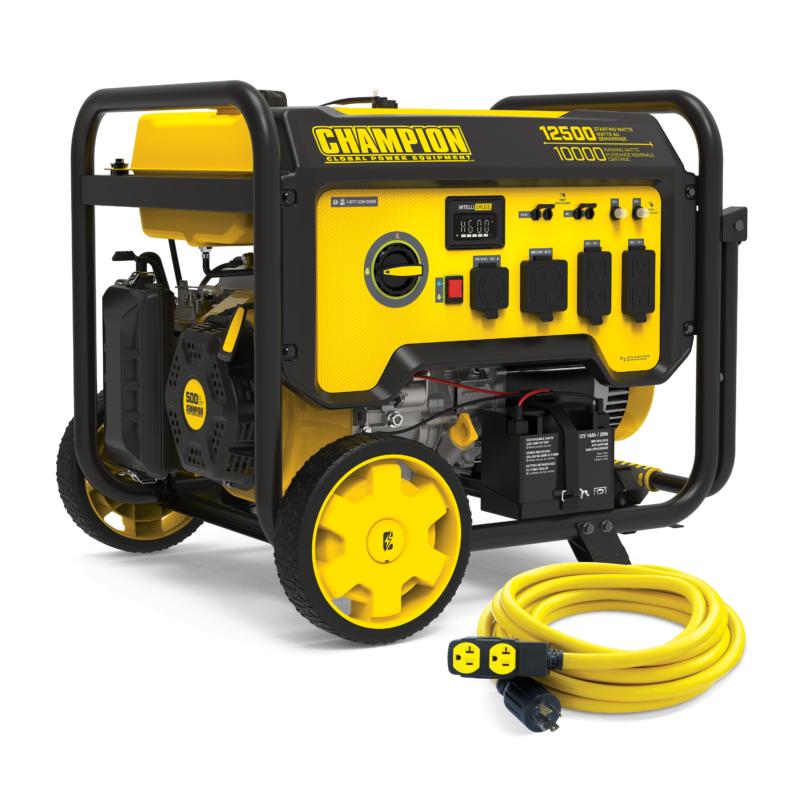
For example, Champion’s 100161 manual distinguishes the ignition switch from a battery switch that disconnects its remote-control module. That is a model-specific example, not a rule for every generator.
Inspect accessible connections
Check for loose cables, corrosion, damaged insulation, and terminals that do not match their markings. A poor connection can mimic a weak battery. Use only the manufacturer’s cleaning and tightening instructions, or have a technician do the work.
Never bridge battery terminals with a tool or bypass a starter solenoid to test the system. For long-term storage, follow the manual’s battery disconnection and maintenance directions.
3. Does Your Generator Charge Its Own Battery?
Check the manual for your exact model and revision. Portable generators can use different arrangements:
- Charging while running: An onboard circuit supplies the starting battery during operation.
- External charging: A supplied charger or approved charging connection is needed between uses.
- Model-specific operating conditions: Some systems require particular operating conditions before they charge.
Do not infer the charging method from brand, electric-start capability, or a socket labeled “12V.” A DC accessory outlet is not automatically a starting-battery charging input.
If the battery repeatedly goes flat despite the correct maintenance routine, have the charging system checked. A damaged cable, failed charger, or charging-circuit fault will not be fixed by replacing the battery alone.
4. Charge With Equipment That Matches the Battery
Read the battery label and generator manual before choosing a charger. Confirm:
- Nominal voltage: Match the battery’s specified voltage.
- Chemistry: Use the correct mode for the actual battery type.
- Charging current: Stay within the battery and generator manufacturers’ limits.
- Connection method: Use approved leads, polarity, and charging points.
- Duration: Follow the specified charging cycle and storage routine.
A large automotive charger is not automatically suitable for a small generator battery. A charger with several modes still requires the correct mode to be selected.
Check that the charger’s power source works and that its indicator shows charging rather than standby or an error. A “full” light is useful information, but it does not replace a battery performance test.
5. Test Before Replacing the Battery
A battery can show voltage yet struggle to supply starter current. If problems continue after a correct full charge and connection check, request a battery test appropriate to its type and rating.

Ask the technician to distinguish battery condition from charging and starting-system faults. If the battery passes but starting remains weak, investigate cables and starter components. If it fails after proper charging and retesting, replacement may be warranted.
Repeated deep discharge can shorten lead-acid battery life. Correct the reason for discharge so the replacement does not suffer the same problem.
6. Match the Replacement to Your Generator
Start with the manufacturer’s replacement part number. If considering an equivalent, verify compatibility with the generator manufacturer or a knowledgeable battery supplier.
| Specification | What to confirm |
|---|---|
| Voltage and battery type | Approved for the generator and its charging system. |
| Dimensions and hold-down | Fits securely without interfering with covers or nearby parts. |
| Terminal position and style | Cables reach the correct terminals without stretching or crossing. |
| Starting capability and capacity | Meets the generator manufacturer’s requirements. |
| Charging limits | Compatible with onboard and external charging equipment. |
Do not assume a lithium battery is a drop-in replacement for lead-acid. Obtain approval for the battery chemistry, starting performance, charging system, and temperature limits.
Follow the manual’s installation order and secure the battery properly. Take the old battery to an appropriate battery retailer or recycling facility.
Keep the Generator Ready Between Outages
- Record the generator model, battery part number, and installation date.
- Use the correct storage switch positions.
- Follow the specified charging or maintenance schedule.
- Inspect accessible cables and battery condition periodically.
- Test electric start before a forecast outage, outdoors in a safe location.
Plan the rest of your setup with our three-day outage fuel guide and generator cord selection guide .
Frequently Asked Questions
Will running the generator recharge a dead battery?
Only if the model has a suitable charging system and the battery can accept a charge. A deeply discharged battery may need approved external charging. Follow your manual rather than running the generator and hoping it recovers.
Can I leave a maintainer connected all winter?
Only if the generator, battery, and maintainer instructions permit that arrangement. Some generators require the battery to be disconnected for aftermarket charging.
Can I use the pull starter with a dead battery?
Some models allow it. Others need battery power for fuel injection or electronic controls even when a recoil starter is fitted. Check before relying on pull start as a backup.
Can I jump-start it from my truck?
Do not assume that is allowed. Follow an explicit manufacturer-approved jump-start procedure or use the specified charging method. Incorrect voltage, polarity, or connections can damage equipment.
Does this apply to a permanently installed standby generator?
This guide focuses on portable generators. Automatic standby units have different charging and control arrangements. Record any charger warning and contact the service provider; do not open the transfer switch or alter internal wiring.
Sources and photo credits
- Generac: Portable generator battery charging guidelines
- Generac: Portable generator starting checks
- Champion 100161 manual: Battery switches, charging, and storage
- Champion: Generator storage guidance
- Yuasa: Battery testing and replacement signs
- NOCO: Example charger modes and operating instructions
- CPSC: Generator safety
Use your exact generator, battery, and charger instructions. Photos illustrate equipment and testing; they do not establish replacement compatibility.