
Generator Running but No Power to the House? Transfer Switch & Interlock Checks
Your generator starts and sounds normal, but the refrigerator stays silent and the lights will not turn on. Before assuming the generator has failed, check which part of the backup-power system is actually supplying electricity.

1. Identify What “No Power” Means
Write down what works before changing settings. A completely dark house, one dead circuit, and power that disappears when an appliance starts point toward different checks.
| What you observe | What to check next |
|---|---|
| No power from any generator outlet you can safely test | The generator’s external breakers, protective devices, indicators, and manual. |
| A small appliance works at a generator outlet, but the house is dark | The specific house-feed outlet, cord, and transfer equipment. One working outlet does not verify every outlet. |
| Only selected circuits work | Whether those are the circuits your transfer system was designed to supply. |
| Power disappears when a large appliance starts | Load demand and the protective device that opened. |
| Lights become unusually bright or dim | Stop using the backup supply and arrange professional diagnosis. |
If the generator itself has no output, see Generator Running but Not Producing Power: Causes and Fixes .
2. Separate Engine Operation From Electrical Output
Use the generator’s manual to identify the breaker protecting the outlet used for the house. A nearby household receptacle may have separate protection.
For an isolated output check, first shut down and disconnect the house cord according to your operating instructions. With the generator correctly positioned outdoors, restart it unloaded as directed. A small, known-working 120V lamp plugged directly into a matching ordinary 120V receptacle can show whether that receptacle supplies power.
This is a limited check: A working lamp does not verify the 120/240V house-feed outlet, both supply legs, or the cord. Do not improvise adapters or insert meter probes into unfamiliar connectors.
Check any output display or fault light against the manual. Reset an external protective device only as instructed after removing loads and addressing the apparent cause. If it will not remain reset, stop.
3. Inspect the Cord and Inlet From the Outside
Before handling connections, remove the load, shut down the generator, and follow the transfer equipment’s disconnection instructions. Inspect the disconnected cord for cuts, crushed sections, bent contacts, discoloration, or melting. Do not reconnect damaged equipment.
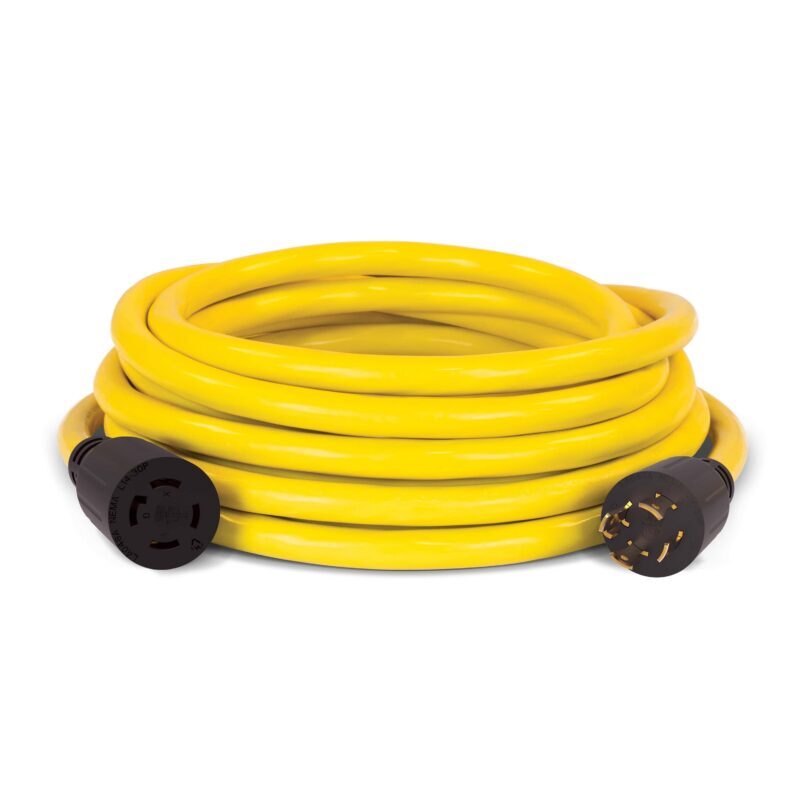
- Match both ends: Check complete connector designations, voltage, and assembly ratings.
- Check seating: Follow the connector instructions for insertion and locking. Do not force a connection.
- Check adapters: Confirm manufacturer-approved compatibility. Physical fit alone is insufficient.
- Check the inlet exterior: Cracks, scorch marks, corrosion, or a loose enclosure require attention before use.
A 120V RV outlet does not become a 120/240V source through an adapter. Read What Generator Cord Do I Need? before replacing the cord or adding an adapter.
4. Confirm Your Transfer Equipment’s Operating Instructions
A manual transfer switch and a panel interlock have different controls. Find your model number, posted operating procedure, and list of backed-up circuits. Do not apply a switching sequence from a different installation.
With a manual transfer switch
Some models have individual LINE/OFF/GEN circuit selectors; others use a single transfer mechanism. A circuit left in OFF receives no power, while one left on LINE may remain dark during a utility outage. Check only normal user controls against the manufacturer’s instructions.
A selected-circuit transfer switch will not supply every circuit in the house. Check an outlet or light that is actually included in the backup system.
With a panel interlock
An interlock mechanically prevents the utility main and generator backfeed breaker from being on together. It does not start the generator or automatically move the breakers.
Follow the electrician’s posted procedure for isolation, connection, and load selection. If the mechanism will not move as intended, do not loosen, remove, or defeat it. Have the installation checked.
For background, read How Generator Interlock Kits Work and Transfer Switch vs. Interlock .
5. If Power Returns, Then Trips Again
Note exactly which breaker or protective device opened and which loads were running. Reduce demand according to the generator’s instructions. Motors and compressors can need substantially more power to start than to run.
A GFCI trip is not the same as an overload trip. Cord faults, connected equipment, and an incompatible neutral arrangement can require different remedies. Neutral bonding and whether the transfer equipment switches the neutral must be evaluated together by a qualified electrician.
Do not remove a generator bonding connection or bypass GFCI protection as a troubleshooting shortcut. Follow model-specific instructions and obtain professional advice. For related symptoms, see Generator Keeps Tripping Breaker: Causes and Checks .
6. When to Call an Electrician or Generator Technician
Arrange service when the external checks do not explain the failure. A generator technician can diagnose output faults; an electrician can trace power through the house connection and verify transfer equipment compatibility.
- The generator supplies a small appliance, but the house remains dark after the correct operating procedure.
- A breaker or GFCI repeatedly trips, including with loads disconnected.
- The cord, inlet, or enclosure shows heat damage or water intrusion.
- The interlock binds or equipment labeling is missing.
- You notice shocks, arcing, or unusually bright and dim lights.
Provide model numbers, connector labels, photos taken with covers closed, the last successful use, and the exact protective device that trips. Avoid opening equipment to collect information.
Frequently Asked Questions
Does a running generator mean it is producing electricity?
No. The engine can operate while an output breaker is open or an electrical fault prevents usable output.
Does a working 120V outlet prove the house connection is good?
No. It verifies only that outlet under the test load. The house-feed outlet, cord, and transfer equipment still need separate evaluation.
Why do some rooms work while others do not?
Your transfer switch may supply only selected circuits. If circuits that normally work on backup suddenly stop working, reduce loads and arrange diagnosis rather than assuming the limitation is normal.
Should I turn the utility main back on to see whether that helps?
Do not experiment with source switching. Follow your installed transfer system’s procedure. Never bypass the mechanism that prevents utility and generator power from being connected together.
Does this guide apply to an automatic standby generator?
The symptoms can overlap, but automatic systems have different controls and service procedures. Record external status messages and contact the authorized service provider. Do not open the automatic transfer switch or attempt to force a transfer.
Start With the Source, Then Check the Connection
Confirm what the generator can power, inspect the disconnected cord externally, and verify the normal operating controls for your transfer system. If the house still has no power, professional testing is the next step.
Sources and further reading
- Generac: Portable generator output troubleshooting
- Generac: Manual transfer equipment and operating instructions
- Champion 100161 manual: Model-specific electrical and GFCI guidance
- CPSC: Generator carbon monoxide and fire safety
Use your equipment manuals and installed operating procedure for model-specific instructions. Product photos illustrate equipment types and do not show a complete installation.