
Switched-Neutral Transfer Switches Explained: Does Your Generator Need One?
A portable generator can have enough wattage, the correct 120/240-volt outlet and the right cord—and still be incompatible with a home’s transfer setup. The overlooked issue is often the neutral connection.
Some generators have a neutral that is bonded to the frame. Others have a floating neutral. At the same time, some transfer switches disconnect the neutral when changing power sources, while most panel interlock kits leave the neutral continuously connected.
The short answer: A bonded-neutral generator commonly requires a transfer switch that also switches the neutral. This isolates the generator neutral from the utility neutral and allows the generator to operate as a separately derived system. A floating-neutral generator is commonly used with a standard interlock or transfer device that switches only the two hot conductors. Always verify the exact generator and transfer-equipment instructions.
What Does “Switched Neutral” Mean?
A normal 120/240-volt residential generator connection has four conductors:
- Hot leg 1
- Hot leg 2
- Neutral
- Equipment grounding conductor
A conventional two-pole transfer device switches the two hot legs between utility and generator power. The neutral remains solidly connected to the home’s service neutral.
A switched-neutral transfer switch also transfers or disconnects the neutral. In a single-phase system, this is commonly accomplished with a fully rated third switching pole. Eaton explains that a switched neutral is commonly used when a transfer switch is supplied by separately derived power sources.
Bonded Neutral vs. Floating Neutral Generators
Bonded-neutral generator
In a bonded-neutral generator, the neutral conductor is electrically connected to the generator frame and grounding system. The generator therefore contains a neutral-to-ground connection.
Floating-neutral generator
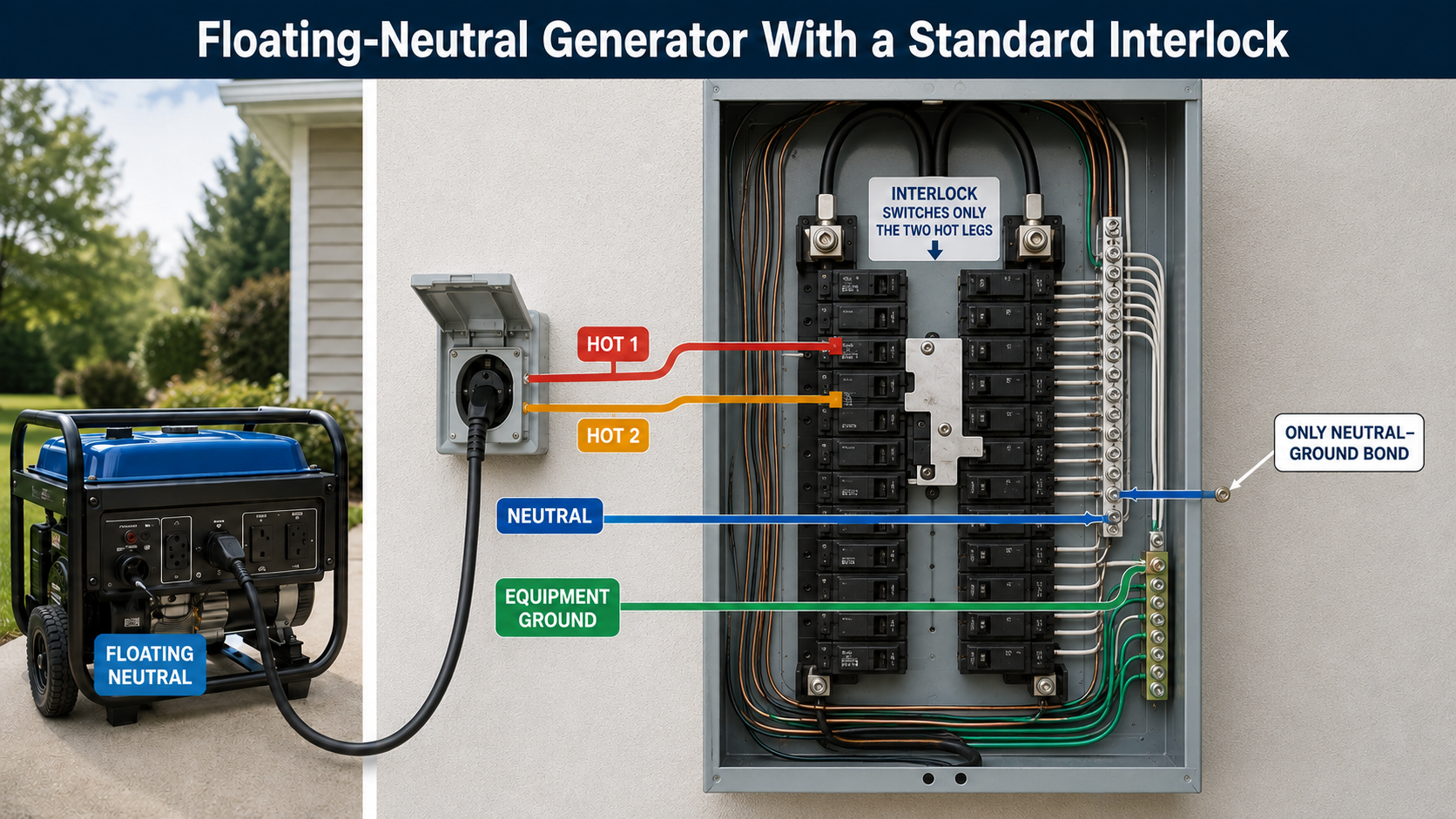
In a floating-neutral generator, the neutral is isolated from the generator frame. When properly connected to a home through transfer equipment that does not switch the neutral, the generator can use the home’s existing neutral-to-ground bond at the service equipment.
Neither design is automatically better or safer in every application. A bonded neutral can be appropriate when a generator powers tools directly or operates as a separately derived source. A floating neutral can be appropriate when the generator feeds building wiring through transfer equipment that keeps the service neutral connected. The complete system—not the generator by itself—determines the proper arrangement.
Why Two Neutral-to-Ground Bonds Can Be a Problem
In a typical home, neutral and ground are bonded at the service disconnect. Downstream panels generally keep neutral and ground separated.
Now imagine connecting a bonded-neutral generator through equipment that switches only the hot conductors. Because the transfer device leaves the neutral connected, these two bonds may exist at the same time:
- The home’s neutral-to-ground bond at the service equipment
- The generator’s neutral-to-frame bond
The equipment grounding conductor between the generator and service equipment can then become a parallel path for normal neutral return current. This is often called objectionable current. Grounding conductors and bonded metal are intended primarily to carry fault current, not a portion of ordinary load current.
A properly designed system prevents this unwanted parallel path. Depending on the listed equipment and manufacturer instructions, the solution may be a switched-neutral transfer device, an approved floating-neutral generator configuration or transfer equipment specifically designed and tested for the generator’s bonded-neutral and GFCI arrangement.
Why a Generator’s GFCI May Trip
A ground-fault circuit interrupter compares current leaving on the hot conductor with current returning through the intended circuit path. If some current returns through the equipment-grounding path instead of through the conductors monitored by the GFCI, the device can detect an imbalance and trip.
With some bonded-neutral, GFCI-protected generators, connecting to transfer equipment with a solid neutral can create an additional return path through the grounding connection. The generator’s GFCI may interpret the imbalance as a ground fault and disconnect power—even when the appliances themselves are not defective.
However, a transfer-switch trip is not proof that every bonded-neutral generator requires modification. Generac, for example, states that portable generators used with its HomeLink manual transfer switches do not require removal of the neutral-to-ground bond. This demonstrates why the compatibility instructions for the specific generator and transfer equipment are more important than a universal rule.
Do Interlock Kits Switch the Neutral?
Most residential panel interlock kits mechanically prevent the utility main breaker and generator backfeed breaker from being on simultaneously. They transfer the two hot legs by controlling the breakers, but they generally do not switch the neutral.
That does not make an interlock unsafe when it is properly selected and installed. It means the generator, inlet, panel, neutral configuration and interlock installation must form an approved non-separately-derived arrangement. A generator with a floating neutral is commonly paired with this type of solid-neutral connection, but the manufacturer’s instructions and local requirements control.
An interlock plate alone also does not resolve neutral compatibility. It prevents dangerous utility backfeed through the hot conductors; it does not automatically correct an extra neutral bond inside a connected generator.
Two-Pole vs. Three-Pole Transfer Switches
| Transfer equipment | What it switches | Neutral arrangement |
|---|---|---|
| Two-pole, single-phase transfer | Hot leg 1 and hot leg 2 | Neutral normally remains connected |
| Three-pole, single-phase transfer | Both hot legs and neutral | Neutral transfers with the power source |
| Typical panel interlock | Controls utility and generator breakers | Neutral is generally not switched |
Do not select transfer equipment only by amperage. A 30-amp or 50-amp rating says nothing by itself about whether the neutral is switched.
What Is a Separately Derived Generator System?
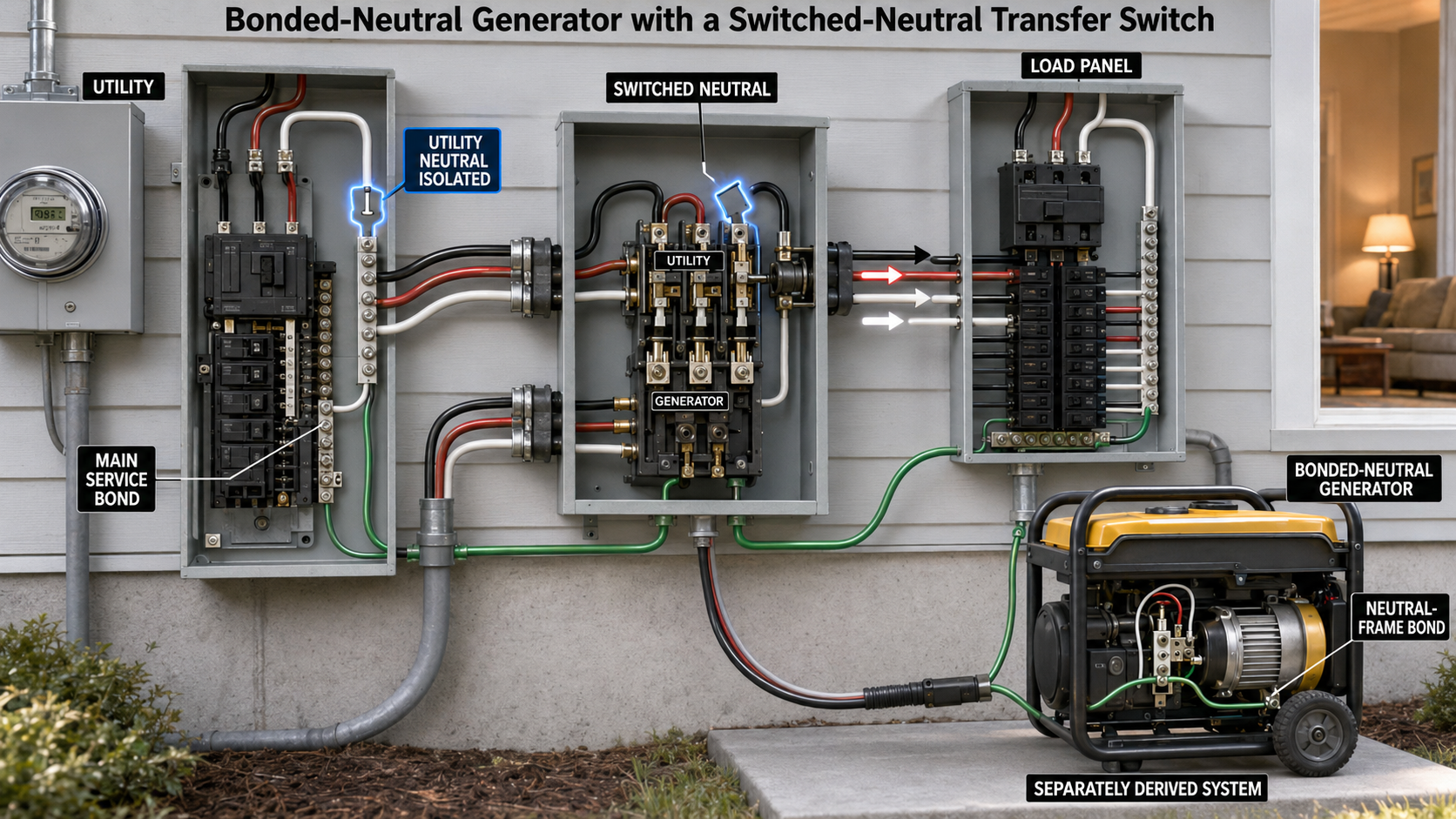
In simplified terms, a generator is treated as a separately derived system when its grounded conductor—the neutral—is not solidly connected to the neutral of another supply. When the transfer equipment switches the neutral away from the utility system, the generator can become a separately derived source while it is supplying the building.
That arrangement normally requires system bonding and grounding provisions appropriate to the derived source. OSHA’s electrical rules likewise state that a neutral conductor must be bonded to the generator frame when the generator is a component of a separately derived system.
If the generator neutral remains solidly interconnected with the service neutral, the generator is generally not treated as separately derived. The service equipment’s neutral-to-ground bond remains the system bonding point.
The important detail in the illustration is not every individual conductor—it is the open utility-neutral connection and the generator’s active neutral-to-frame bond.
Can You Remove the Generator’s Neutral Bond?
Do not assume that you can simply disconnect it. On some generator models, the manufacturer provides an approved procedure or configuration for changing the neutral arrangement. On others, altering the bond may violate the instructions, affect the product listing, interfere with receptacle GFCI protection or create a hazard when the generator is later used as a stand-alone power source.
A generator converted for one application can be unsafe or incompatible in another. For example, a configuration intended for connection to a home’s bonded service may not provide the intended fault-clearing path when the generator is later used by itself with extension cords.
Before changing anything, check:
- The exact generator model and serial-number-specific manual
- Whether the generator is labeled bonded neutral or floating neutral
- Whether the main generator output is GFCI protected
- Whether the manufacturer authorizes changing the neutral configuration
- Whether the transfer device switches the neutral
- The transfer-switch compatibility documentation
- Local inspection and code requirements
How Can You Tell Whether a Generator Is Bonded or Floating?
Start with the generator’s data label and owner’s manual. Manufacturers commonly identify the unit as neutral bonded to frame or floating neutral.
A continuity or resistance test between neutral and the equipment-grounding contact may also help a qualified person identify the configuration, but the generator must be completely shut down, isolated from all cords and wiring, and tested according to the manufacturer’s instructions. Electronic components, filters and connected equipment can otherwise produce misleading readings.
A plug-in receptacle tester may report “open ground” on a floating-neutral generator. Generac notes that this is common because no neutral-to-ground bond exists at the generator. That display alone does not necessarily mean the generator’s grounding contact is physically disconnected.
Does a Ground Rod Fix a Neutral-Bond Problem?
No. A grounding electrode and a neutral-to-ground bond perform different jobs. Driving a ground rod does not remove an unwanted parallel path between neutral and equipment ground, and it does not make incompatible transfer equipment compatible.
Grounding-electrode requirements depend on how the generator is used and connected. A portable generator supplying only cord-and-plug-connected equipment from its own receptacles may be treated differently from one connected to a building’s fixed wiring. Follow the generator manual, transfer-equipment instructions and local electrical requirements.
Quick Compatibility Guide
| Generator/setup | Likely design direction | What must be verified |
|---|---|---|
| Floating-neutral generator with a typical interlock | Solid-neutral, non-separately-derived arrangement | Generator manual, inlet, breaker, interlock listing and local approval |
| Bonded-neutral generator with switched-neutral transfer equipment | Separately derived arrangement | Transfer sequence, bonding, grounding and equipment instructions |
| Bonded-neutral, GFCI generator with manufacturer-approved transfer equipment | Use the manufacturer’s tested configuration | Exact model compatibility; do not assume all switches behave alike |
| Bonded-neutral generator with a typical solid-neutral interlock | Potential duplicate bond and GFCI issue | Manufacturer-approved solution and electrician evaluation required |
This table describes common arrangements, not approval for a particular installation.
Frequently Asked Questions
Does every bonded-neutral generator need a switched-neutral transfer switch?
No. A switched neutral is a common solution when the generator is used as a separately derived source, but some transfer equipment is specifically designed for bonded-neutral, GFCI-protected generators. Confirm compatibility for both exact models.
Does a transfer switch automatically switch the neutral?
No. Many transfer switches switch only the hot conductors. Look for terms such as “switched neutral,” “three-pole single phase” or a fully rated neutral switching pole in the specifications.
Does a panel interlock switch the neutral?
Generally, no. A typical interlock coordinates the main and generator breakers while the neutral remains connected to the service neutral.
Why does my generator run normally with extension cords but trip when connected to the house?
The house connection may create an additional neutral or ground-current path that the generator’s GFCI detects. It may also indicate a genuine wiring fault. Stop using the setup until the generator and transfer equipment have been evaluated together.
Will a ground rod stop the GFCI from tripping?
No. A ground rod does not correct an incompatible neutral-bond arrangement or eliminate parallel neutral current.
Can I use an adapter to solve the neutral issue?
No ordinary plug adapter changes the system’s bonding design safely. Never use an adapter that removes the equipment-grounding connection or defeats GFCI protection.
The Bottom Line
The real question is whether the generator, GFCI protection, cord, inlet, transfer equipment, service bond and grounding system are designed to work together. A switched-neutral transfer switch is commonly used with a bonded-neutral generator operating as a separately derived source, while a typical interlock leaves the neutral connected and requires a compatible neutral arrangement.
Check the instructions for both products before purchasing equipment or changing generator wiring. Some purpose-designed transfer equipment can accommodate bonded-neutral, GFCI-protected generators without removing the bond, so exact model compatibility matters.