
Backup Power Basics
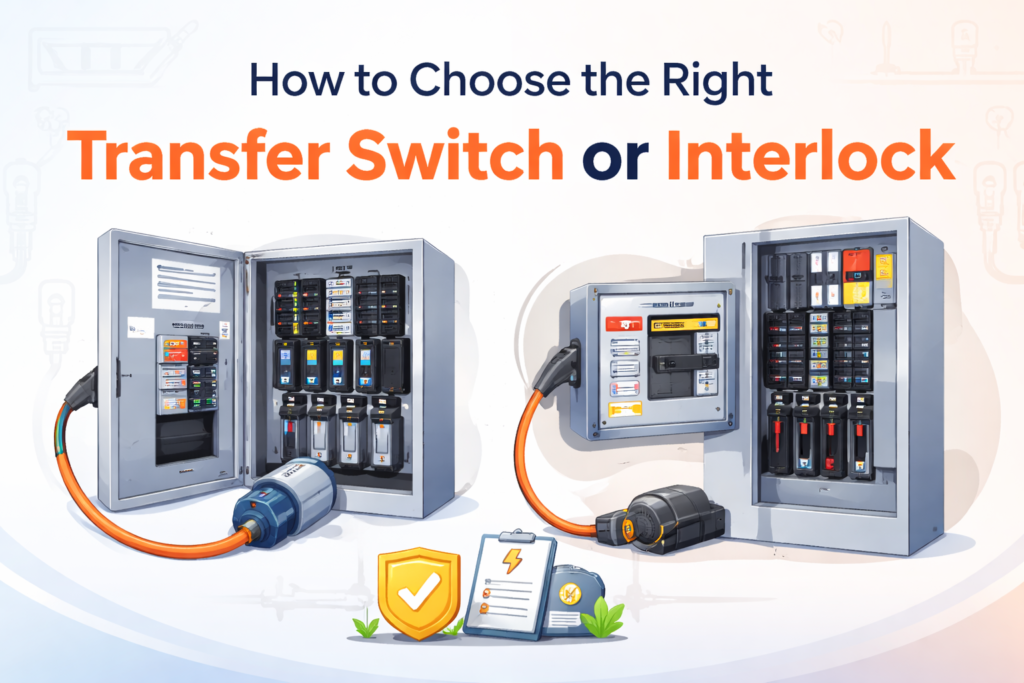
How to Choose the Right Transfer Switch or Interlock
Safe backup power starts with proper isolation. This guide helps you choose the most appropriate code-compliant method based on safety, cost, and how you plan to operate your generator.
Why This Decision Matters
Power interruptions are more than a temporary inconvenience. An incorrectly applied generator connection can lead to equipment damage, rejected insurance claims, or—most critically—hazardous backfeeding that endangers utility workers and violates electrical code. A properly installed isolation method protects your home, your equipment, and the people working to restore power.
Backfeed is illegal and dangerous. Any setup must prevent generator power from energizing the utility grid.
Don’t guess on wiring. If you’re using an inlet, interlock, or transfer switch, read this first:
What This Guide Covers
- The functional differences between transfer switches and interlock kits
- How to evaluate safety, cost, convenience, and electrical load requirements
- Core NEC 702 compliance concepts and non-negotiable safety practices
- A practical installation overview and common user misconceptions
Quick Reference Glossary
- Transfer Switch – Disconnects the home from the utility grid before generator power is applied. Available in manual and automatic configurations.
- Interlock Kit – A UL-listed mechanical panel plate that prevents the generator breaker and main breaker from being ON at the same time. Manual only.
- Inlet Box – An exterior generator connection point (typically 30A or 50A) that feeds power into the home through rated wiring.
- Backfeed – Generator power unintentionally flowing into the grid (illegal and unsafe).
The Core Question
What is the safest, legal, and most cost-effective way to energize a home during a power outage?
The right choice depends on generator type, household load demands, budget, and desired simplicity — but the foundation is always the same: isolation, accurate sizing, and disciplined procedures.
Transfer Switch vs Interlock — Side-by-Side
| Criteria | Transfer Switch | Interlock Kit |
|---|---|---|
| Safety | Purpose-built for isolation; lowest risk of user error | Safe and compliant only when UL-listed and correctly installed |
| NEC 702 | Fully compliant when installed properly | Compliant when UL-listed and installed per manufacturer instructions |
| Upfront Cost | Higher investment ($500–$2,000+ installed) | Budget-friendly ($150–$400 installed) |
| Operation | Manual or automatic options | Manual only |
| Circuit Access | Selected circuits (or whole-panel models) | Full panel access, limited by generator capacity |
| Overload Risk | Reduced risk — only supported circuits energize | User must manage load to avoid overload |
| Install Complexity | High (subpanel wiring; electrician strongly recommended) | Moderate (panel modification; electrician recommended) |
Which Option Is Right for You?
Choose a Transfer Switch if:
- You want automatic transfer or future standby generator compatibility
- You prefer backing up essential circuits only
- You want the lowest margin for user error
- Your home has complex or high-demand electrical loads
- Convenience matters more than upfront cost
Choose an Interlock Kit if:
- You’re using a portable generator (not standby)
- Budget is a top priority
- You want full panel access during outages
- You’re comfortable manually managing loads
- You want a simpler install without creating a subpanel
Generator Size Still Determines Your Limits
An interlock gives you access to the whole panel — but it does not increase generator capacity. Your inlet and generator output still set hard limits.
- 30A inlet → ~3,600W max usable load
- 50A inlet → up to ~12,000W panel feed only if the generator can supply it
Practical tips if your generator is smaller than your panel access
- Consider soft-start kits for air conditioners
- Plan load shedding (run only what your generator can handle)
- Size your generator to your real expected load — not best-case assumptions
Non-Negotiable Safety Checklist
- ✓Always isolate the utility grid before energizing generator power.
- ✓Use only UL-listed or manufacturer-approved equipment.
- ✓Install per NEC 702 (Optional Standby Systems) and local code requirements.
- ✓Use a proper inlet box — never improvised outlets (no “dryer hacks”).
- ✓Label the panel with clear generator procedures.
- ✓Train everyone in the home on startup and shutdown sequencing.
- ✓Follow grounding and bonding requirements for your generator type.
Installation Overview (High-Level)
Note: This is not a replacement for a licensed electrician. Always consider permits and inspection requirements in your area.
- Install the inlet box outside (30A or 50A).
- Install the transfer switch or UL-listed interlock at the main panel.
- Install a generator breaker in the panel.
- Run appropriately rated wiring (correct gauge, correct insulation rating).
- Apply labeling + train the household on procedures.
- Schedule inspection if required locally.
Most Common Mistakes
- Assuming an interlock equals unlimited whole-house power
- Using homemade or non-listed interlock plates (illegal)
- Undersizing the generator for the desired load
- Skipping grounding/bonding steps
- Not checking local inspection or utility notification requirements
Final Takeaway
Safe backup power is: Isolation → Sizing → Procedure
Before committing to a setup, define your real load, confirm generator capacity, set a budget, and choose the isolation method that protects people first, equipment second, and stays code-compliant.
Do this in order
- Define your real electrical load (what you must run vs what’s optional).
- Check generator capacity (running watts + surge/headroom).
- Set a budget (equipment + professional installation where needed).
- Choose the isolation device that stays safe and compliant.
Transfer-Switch-Vs-Interlock
Transfer Switch vs Interlock — Quick Quiz
Choose the best answer for each question, then submit to see your score and explanations.