Watts, Volts, Amps, kWh, Surge
If you learn five terms—watts, volts, amps, kWh, and surge—you can size backup power correctly, avoid the “it should work” mistakes, and spend money where it actually matters.
Why “Power Basics” Matters
Most bad backup power buys come from mixing up these words: watts (power right now), watt-hours/kWh (energy over time), and surge (the startup kick for motors).
- You buy a generator that “should” run a fridge… but it won’t start it.
- You buy a battery “rated 2000W”… and it still dies fast.
- You underestimate loads by reading the wrong label on appliances.
The 5 Terms You Actually Need
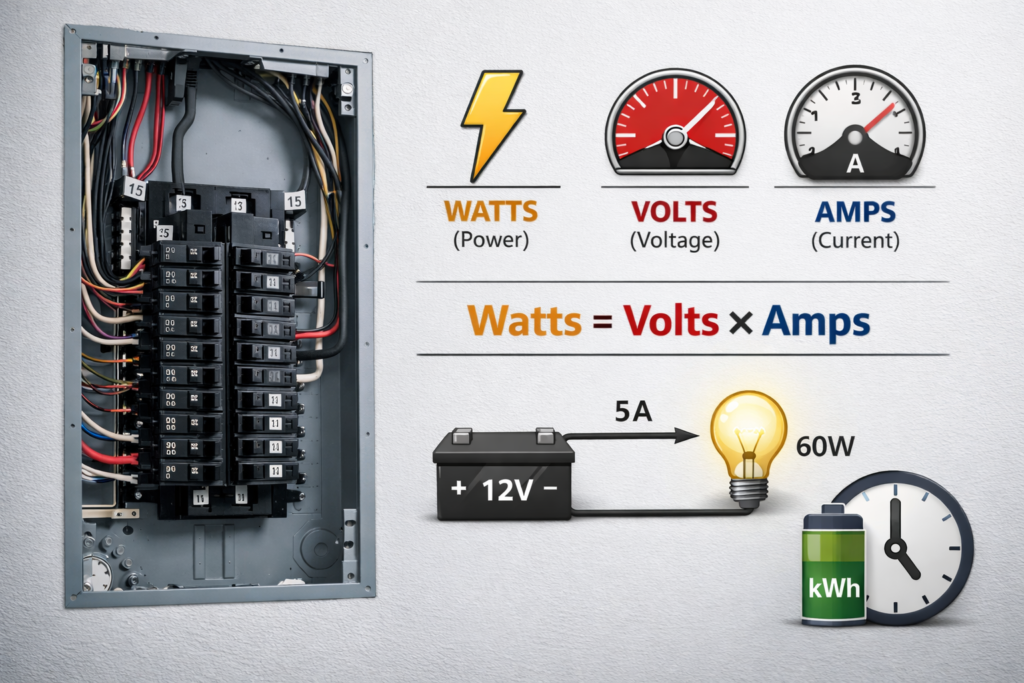
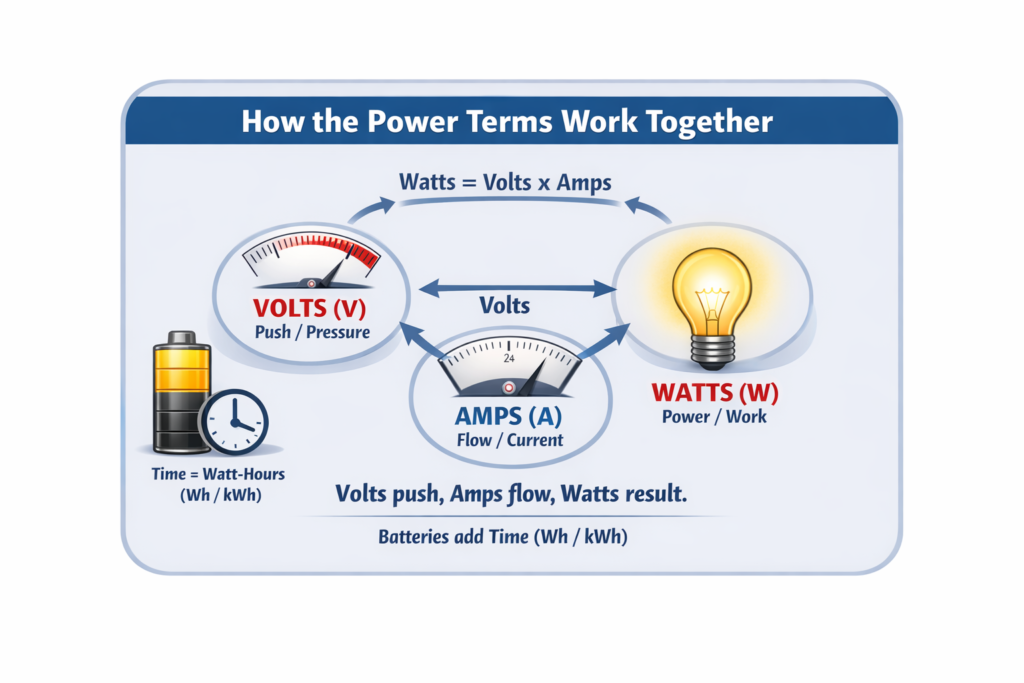
Watts are the instant demand of an appliance while it’s running.
- A 600W sump pump draws ~600W while running
- A 1500W heater draws ~1500W while on
Most homes use 120V and 240V circuits.
- Lights/TV/fridge: usually 120V
- Well pump/dryer/range: often 240V
Amps are how much current a device draws from a circuit.
This is battery math: Watts = how hard right now. Watt-hours = how long.
Motors/compressors briefly draw more power at startup than during normal running.
- Fridges/freezers
- Well pumps / sump pumps
- Furnace blowers (often)
The Only Formulas You Need
Clean Reference Table: What These Units Mean
| Term | What it measures | Quick meaning | Where it matters most |
|---|---|---|---|
| Volts (V) | Electrical “pressure” | 120V vs 240V circuits | Whole-home loads, inlet/transfer setup |
| Amps (A) | Electrical flow | Current a device draws | Breakers, wiring, safe circuit use |
| Watts (W) | Power right now | Running demand | Generator / inverter sizing |
| Watt-hours (Wh) | Energy over time | How long you can run it | Battery runtime |
| Kilowatt-hours (kWh) | 1000Wh | Big-picture energy | Utility bills, large battery systems |
| Surge watts | Short startup spike | Motor “kick” | Starting fridges/pumps/blowers |
Running Watts vs Startup Watts (Real Example)
A fridge might be:
- Running: 150W–300W
- Startup surge: 600W–1200W (short burst)
1) Add up your running watts (what stays on).
2) Add one big surge (largest motor start).
3) Add a small buffer.
Use the Load Assessment tool to do this without guessing.
Common Power Mistakes That Break Backup Systems
“2000W battery” tells you peak output, not runtime. Runtime comes from Wh/kWh.
Motors won’t start even though your running watt total looks fine.
This is how you overspend. Pick the essentials first, then expand later.
Many meaningful home loads are 240V and need the right generator setup.
Appliance Reality Check
| Appliance | Running Watts | Surge Watts | Battery-Friendly? |
|---|---|---|---|
| LED lights | 10–100W | None | Excellent |
| Wi-Fi + modem | 15–60W | None | Excellent |
| Fridge | 150–300W | 600–1200W | Short-term |
| Microwave | 1000–1500W | Same | Drains fast |
| Space heater | 1500W | None | Poor choice |
| Sump pump | 600–1200W | 2–3× surge | Generator best |
| Well pump | 1000W+ | 2–3× surge | Generator best |
Generator vs Battery: Why the Same Load Feels Different
- Great at handling surge
- Run as long as fuel is available
- Sized mainly by watts
- Quiet, instant, no fumes
- Limited by stored energy (Wh/kWh)
- Best for electronics + short runs
Recommendations (Simple Plans That Actually Work)
- Identify critical loads (fridge, sump, blower, router)
- Add running watts + biggest surge
- Choose a generator size that starts motors reliably
- Use UPS for modem/router + desktop + networking gear
- Use a power station for longer runtime if needed
- Avoid heaters and big cooking loads on batteries
What to do next
Now that you understand watts, volts, amps, kWh, and surge, the next step is simple: write down what you actually need to run, then size to that list.
Explore Generator Options
Answer one quick question to see what class of generator usually fits your situation — then learn how to size it properly.
What do you want to power during an outage?