120V vs 240V in Your Home (And How Generators Connect to a Breaker)
Most U.S. homes use both 120V and 240V. That doesn’t mean your breakers “create” those voltages — it means your electrical service delivers them, and the panel distributes them. This guide makes it simple with diagrams and a quick quiz.
Key takeaway
Voltage (120V vs 240V) depends on whether the breaker connects to one hot leg or both.
Common questions
• “Is 120V/240V the breaker’s capability?”
• “Why do some breakers take up two slots?”
• “Does my generator feed the panel with 120V or 240V?”
1) Where 120V and 240V come from
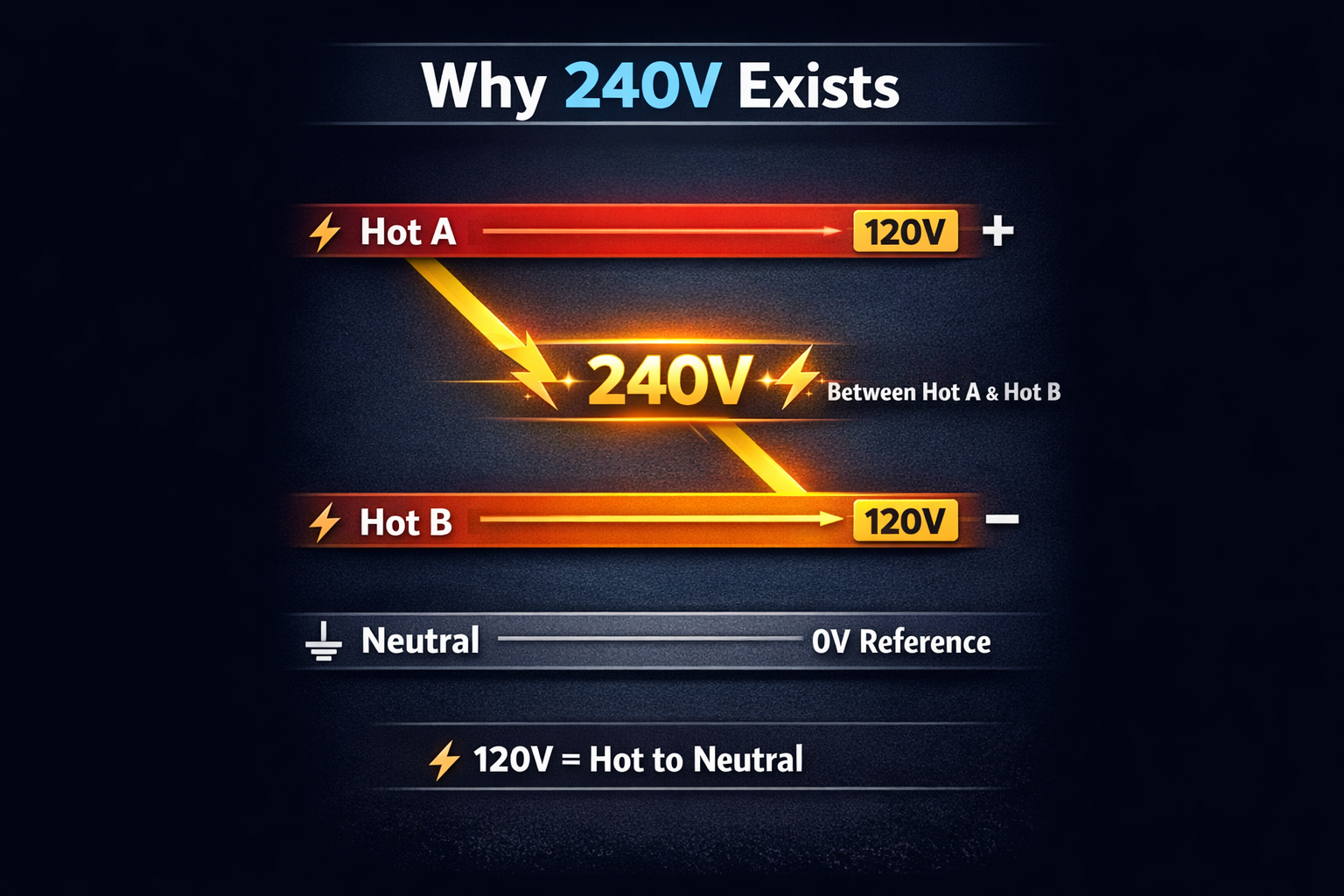
Your home typically receives split-phase 120/240V service from the utility transformer. That means you have two “hot legs” and a neutral. The panel simply distributes what’s already supplied.
Hot Leg A  = 120V to Neutral
Neutral    = 0V reference
Hot Leg B  = 120V to Neutral

A ↔ B = 240V (between hot legs)
A ↔ N = 120V (hot to neutral)
B ↔ N = 120V (hot to neutral)
2) What breakers actually do
A breaker’s job is to protect the wire by limiting how much current (amps) can flow. That’s why breakers are labeled 15A, 20A, 30A, 50A, etc.
| Breaker | What it means | Typical examples |
|---|---|---|
| 15A / 20A | Standard branch circuits (amps rating) | Lights, outlets, kitchen circuits, small appliances |
| 30A | Higher-current load | Dryer, RV inlet, some water heaters |
| 40–60A+ | Large loads | Range, EV charger, HVAC, subpanel feed |
Single-pole vs double-pole breakers
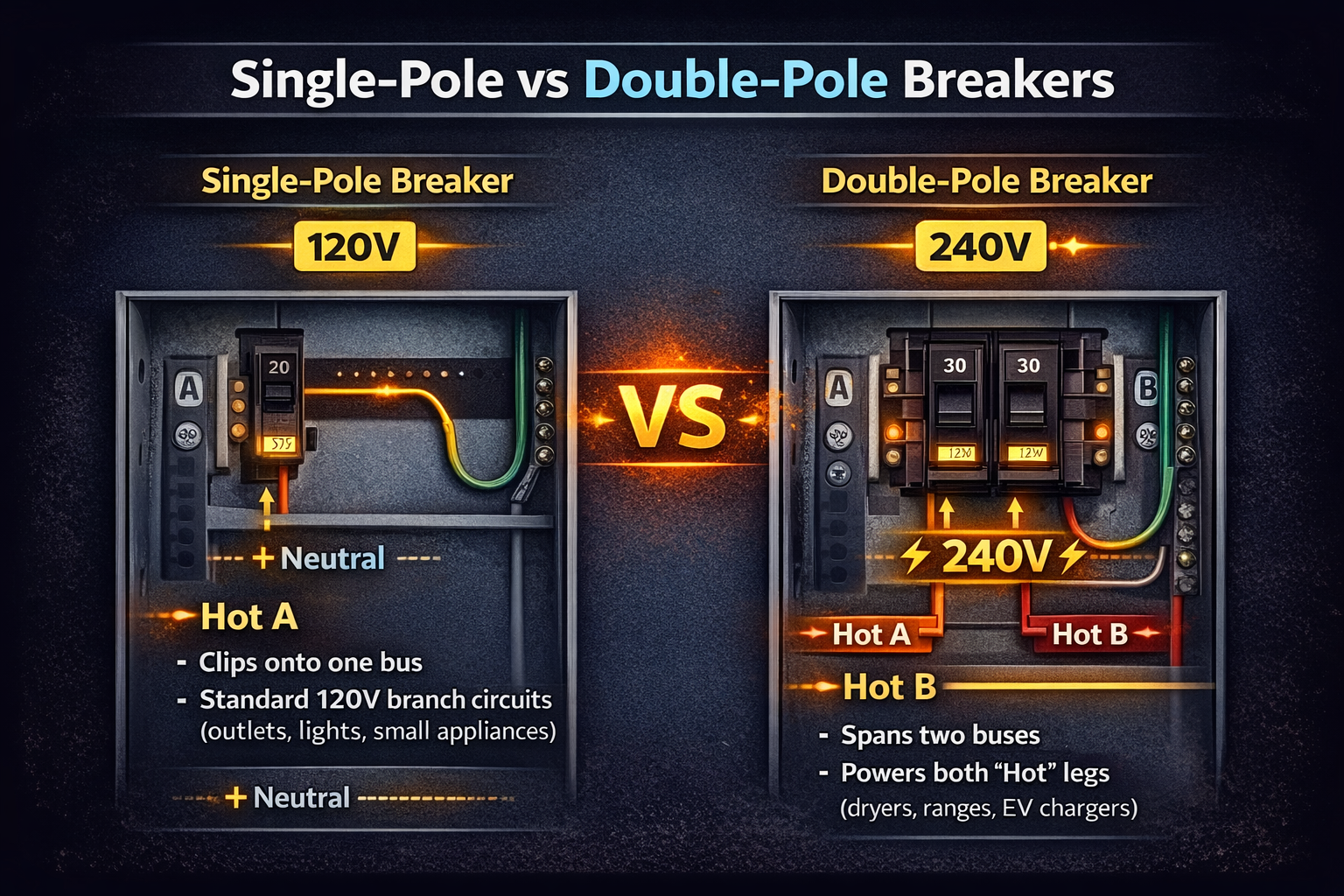
Voltage depends on how the breaker connects in the panel. Here’s the simplest visual:
Panel bus bars (simplified)
[A] [B] [A] [B] ...

Single-pole breaker clips onto ONE bus:
  120V = Hot (A or B) + Neutral

Used for: outlets, lighting, small loads
Panel bus bars (simplified)
[A] [B] [A] [B] ...

Double-pole spans BOTH buses:
  240V = Hot A + Hot B

Used for: dryer, range, HVAC, well pump
3) How a generator connects to a breaker
A proper generator hookup uses a power inlet and a generator backfeed breaker in your main panel, protected by either an interlock kit or a transfer switch. This prevents dangerous backfeeding to the utility lines.
Does a generator connect through 120V or 240V?
Here’s the clean mental model:
Generator (120/240V) → Inlet box → 2-pole breaker (panel) → Panel bus bars
                                       |
                                   Interlock / Transfer
If your generator is 120V-only: it may energize only one “leg” of the panel, which can leave half your 120V circuits dead and prevents true 240V loads from operating.
4) Why this matters for backup power
If you choose the wrong generator output (or don’t understand how it feeds your panel), you can lose critical loads like a well pump, HVAC equipment, or other 240V appliances. Understanding 120V vs 240V makes your generator sizing and transfer setup decisions much easier.
Quick Quiz: 120V vs 240V + Generator Feed
Note: This is guidance, not a test. Ties and “it depends” moments are common in real-world setups.